11 May 2010

On game-changing

I have my doubts about "reflection" as a panacea for professional development, despite the title of this blog. But in practical terms, my most effective learning from experience occurs when I find that themes from several different instances/areas/events/ideas come together to make a point.
But! I find myself warning some of my best and most curious students (I don't mean "freakiest", although the categories are not mutually exclusive...) against producing spurious syncretist theories of everything. I may be guilty of that, too.
What prompts this thought is a political debate (of course), editing a video (discussed more in the 10 May post), and a TV series on the history of science.

Politically, proportional representation as a form of electoral reform is a game-changer. It's irreversible short of a period of anarchy/revolution. I'm all for it, incidentally, as long as the system maintains an adequate link between representative and locality (which is a little more specific than "constituency"). But it is a BIG step.

It's an instance of second-order change (Watzlawick et al 1974)
  • First-order change: Plus ca change, plus c'est la meme chose... The more things change, the more they stay the same (attributed to Karr, 1849)
  • Second-order change: Things will never be the same again.
I note in the post on 10 May "On another threshold concept, rediscovered" that Kuhn's notion of "paradigm shifts" is an instance of second-order change in the history of science. Mosley's excellent BBC2 series (linked to above, and on again at 9pm today) has very effectively explored such instances, and in so doing demonstrated that--for later students--they constitute threshold concepts.

The video includes some plenary discussion of students' conceptions (and misconceptions) of threshold concepts, and watching it over and over again for editing purposes is a good way of at least forming some hypotheses about their understanding (getting feedback from them, as Hattie emphasises). I am struck by how "safe" are the TCs they chose to mention, in particular. As commentators Peter H and myself found ourselves challenged potentially to accept the proffered examples as they stood, even when they did not quite hit the target--thereby running the risk of diluting the idea to the status of "statements of the bleeding obvious", which a few students obviously thought we did, from their evaluations. Apart from the initial statement about the limitations of the applicability of TCs to practice with students with Special Education Needs, clearly students did not want to "show themselves up" in front of the assembled multitude by risking a contentious suggestion. And interestingly, few referred to their own learning of their discipline--which was what the exercise asked--but reverted to issues about teaching it.

What all this is reminding me of, apart from the general point about the much-neglected emotional agenda in teaching and learning, is just how disconcerting and disorienting is the liminality of TCs, and how much people may avoid it, because they have not got their bearings in the new space. Just as I hear politicians on the radio resiling for fear of what lies beyond the portal of PR, which is indeed scary until you think that it is what every other European democracy bar one uses. Just like scientists wishing no-one had ever discovered quantum physics.

    10 May 2010

    On another threshold concept, rediscovered

    Threshold concepts are not only like portals, they are also like buses. You wait ages for one, and then three come along together.

    I've been editing the video of our joint presentation on them at a Study Day last month (here) so I am sensitised to keep finding (or rediscovering) them.

    Today I was listening in the car to a Radio 4 (of course) programme in which "Matthew Taylor discovers what the latest scientific research can tell us about the human need for religion". In the programme, he interviewed anthropologist David Sloan Wilson (Darwin's Cathedral Chicago; U Chicago Press, 2002) who drew the distinction between "practical" (survival oriented) beliefs and "factual" (accurate/truthful) ones, and averred* that in the real world practical beliefs win every time. And in order to practise as an anthropologist, you need to adopt the perspective of the practicality/utility of a belief rather than its factual accuracy. That is a threshold concept. It is a dizzying prospect. But a moment's thought shows how it opens up the way into a new and potentially fruitful understanding of other people's beliefs.

    I was only struck by this because I am sensitised to look for TCs at the moment. I myself made a similar point about the nature of myth in ch. 6 of Atherton (1989). I make no great claim for this insight. I was merely making a point in passing about what I meant by "working myth". And interestingly, I suspect that most of my (very few!) readers, thought, "OK, so what?" and plodded on to more interesting and relevant stuff.

    So, the idea needed a context in order to become a TC. It is the interaction between the discipline and the TC which gives the latter the potential to transform understandings. Drop an explosive idea into a tank of inert gas, and nothing happens. Drop it into oxygen and all hell breaks loose.

    More precisely it is to do with how closely-coupled is the contextual system. A TC in the form of a paradigm shift (Kuhn, 1962) --when accepted--overturns the consensus of "normal science". Generally speaking a similar bomb in the humanities splutters into oblivion enveloped by tenuously connected fluffy fibres of unconnected meanderings......

    Which poses the question of how the humanities were hi-jacked by "Theory" Assuming the contention is correct (I'm not convinced, but I have to admit that it is more fun than scholarship)...

    *  I've been waiting for years for a chance to use that word!

    Atherton J S (1989) Interpreting residential life: values to practise London; Tavistock

    06 May 2010

    On the election

    What's Iain Dale doing plugging a Labour candidate's blog? Watch and enjoy!

    05 May 2010

    On a succinct account of the ills of English education, from policy to practice

    Something to think about as we consider the possibility of yet more change in the system from tomorrow.

    Yes, but what has Semmelweis to do with my professional development as a tutor?

    "This report asks the poignant question of teaching professionals - 'What changes do I need to make to those aspects of my professional thinking and practice which I suspect are doing more harm than good?' This was the central question posed by Ignaz Semmelweis, a young Hungarian doctor who, as a result of painstaking research, reduced mortality rates in childbed fever to less than 1% by challenging the practices of his contemporaries in 19th century Vienna. Now, more than 150 years later, Professor Frank Coffield, Emeritus Professor of Education at the Institute of Education, examines how we can use this remarkable story to challenge and improve some current professional practices in teaching and learning." (From the publisher's blurb)

    Free download (pdf) from the Learning and Skills Network.

    27 April 2010

    On PowerPoint's unintended consequences

    (See also Edward Tufte on Powerpoint here--a detailed discussion of NASA's use of PowerPoint in relation to the Columbia disaster of 2003-- and more generally here.)

    The link is to an article in the (US) Armed Forces Journal (thanks to the Browser for the link) about the impact of using PowerPoint on staff decision-making in the Forces. It sees the very fact of using a presentation as changing the manner of passing on information, of conducting discussions, and of making the decisions. It even changes the structure of staff officers' working days. I have no idea whether or not is an accurate account, but it is an exemplary piece of analysis of the unintended effects of a minor technological change.

    Interestingly, the author (a retired Marine officer now undertaking a doctorate at Oxford) largely exempts the use of PPt as an instructional tool. Tufte is much more scathing about that usage, too. It is a matter worthy of much thought among teachers and lecturers.

    Update:  See also here and here, and (28 April) here.

    25 April 2010

    On problem-solving crows

    I've used Betty the Crow (bottom of the page) as an example of animal problem-solving for some time, but this material from New Zealand puts her in the shade.

    21 April 2010

    On cited authors in the humanities (2007)

    Foucault came top.  D G Myers comments, concluding;
    The “enchanting crisscrossing of names” from France—Foucault, Bour­dieu, Derrida—suggests that humanists remain bogged down in the slough of Theory. They are engaged in a common pursuit, all right, but it is not the pursuit of truth. It is the pursuit of intellectual fashion, even if the fashion is a little worn and threadbare after four decades.
    I've got a lot of sympathy with that viewpoint, although it's a bit tough on Bourdieu, who may be unreadable but has more going for him than those other posturing purveyors of intellectual flatulence.

    But one is bound to be disappointed if one sees studies in the humanities in terms of the "pursuit of truth" with a sub-text of the possibility of making "progress". I don't even see what would count as "progress" in those areas.

    On the other hand, note that the list includes Albert Bandura at number 4, Anthony Giddens at 5 and Erving Goffman at 6. All of them have a body of empirical (and incidentally very accessible) work to their credit, and may indeed be credited with useful new knowledge, sometimes in terms of answers, but sometimes too in terms of new questions. What of course the current authors were doing as they cited them is a different matter--probably rubbishing them! Citations cut both ways.

    16 April 2010

    On academic writing, again

    The link is to a salutary essay on pretentious and obscure academic writing--worthy of note particularly at this time of the academic year, as people prepare their assignments and dissertations.

    The author (Rachel Toor) cites George Orwell on modern (not so modern, actually, given that he was writing in 1946) academic prose: "It consists in gumming together long strips of words which have already been set in order by someone else, and making the results presentable by sheer humbug."

    10 April 2010

    On getting others to mark student work

    It's not just call-centres now--the linked piece is about how a professor in Texas is out-sourcing the marking of assignments to India. She and the entrepreneurs running the service in India make a good case; her teaching assistants are not trained or even skilled enough to mark, she has enrolments of up to 1,000 students, and each of them produce 5,000 words... It facilitates using essays, projects and report--free-text writing--rather than computer-marked multiple-choice and short-answer questions. The students get a faster turn-around, too.

    But what I found particularly interesting were the comments--81 of them when I last looked--which are overwhelmingly hostile. The first two pick up on a major shortcoming, which is that while the students may be getting good feedback, the professor is not getting the feedback about their understanding she would if she actually read at least a sample herself.

    I have mentioned before the work of John Hattie (here) and discussed it (currently being revised) here. I'm currently reading--indeed, I have even bought--his excellent Visible Learning... London; Routledge 2009. His syntheses of meta-analyses has lead him to emphasise the importance of feedback / formative assessment / "assessment for learning" etc., but;
    ...one of the major results presented in this book relates to increasing the amount of feedback because it is an important correlate of student achievement. However, one should not immediately start providing more feedback and then await the magical increases in achievement. [...] increasing the amount of feedback in order to have a positive effect on student achievement requires a change in the conception of what it means to be a teacher; it is the feedback to the teacher about what students can and cannot do that is more powerful than feedback to the student, and it necessitates a different way of interacting and respecting students  [...].  [...] It is important to be concerned about the climate of the classroom before increasing the amount of feedback (to the student or teacher) because it is critical to ensure that "errors" are welcomed, as they are key levers for enhancing learning. It is critical to have appropriately challenging goals as then the amount and directedness of feedback is maximized. Simply applying a recipe (e.g.,"providing more feedback") will not work in our busy, multifaceted, culturally invested, and changing classrooms. (Hattie, 2009 p.4; emphases added)
    One of the limitations of end-of-module assessment is that this information arrives too late to use it for the current cycle (and the next one may be different) but it is streets ahead of no such information; and although it may have received little direct attention as you sit and plough your way through interminable assignments, its message is quite likely to have got through.

    09 April 2010

    On being canvassed

    In my more politically active days, door-to-door canvassing scored bottom out of the range of preferred activities. (Even that scored higher than door-to-door evangelism in my more religiously active days.)

    I read something in the past few days about how it has all changed in the internet era. I can't find it to link to it, but you can reconstruct the argument for yourselves in half a minute.

    I know how I am going to vote. My partner has a "plague on all your houses" approach, and won't vote (I don't agree of course but that is not the business of this blog). So people will be wasting their time calling round; I've decided to save them and us a lot of trouble with the following notice on our front door:
    To all candidates and canvassers:
    Please do NOT call or deliver leaflets.
    To do so guarantees that we will not vote for your party.
    Thank you
    (No copyright claimed--feel free to copy and distribute, and of course improve... On reflection. "So to do" is more elegant than "To do so", ..)

    This is win-win. You don't get bothered, and canvassers will be relieved to know that there is no point in expending time and effort where it will clearly be counter-productive.

    And of course there are variants. I don't write it down, but I do set out the ground rules for when the Jehovah's Witnesses come round, which they do regularly round here;
    Thank you for calling! My great-aunt was a Witness and played the organ at the local Kingdom Hall (true) I have the greatest respect for your commitment, and particularly the suffering of Witnesses under the Nazis but...

    you are not going to convert me, and I don't even want to convert you.

    ..but I really enjoy theological arguments, and although my Biblical scholarship is a little rusty, it will all come back to me. So if you have a couple of hours to spare, let's make a date...
    The last time anyone took me up on that was 40+ years ago.

    This is not about cheap points at the expense of political or religious canvassers, but about understanding the pressures on them. The last thing they want is an enthusiastic time-waster. Pity! It's great fun. I can recommend it.

    PS. If a canvasser of whatever ilk asks you a question, please don't answer it directly, as posed. That marks you as a mug/prole/voter. Apart from the crude "litany" recitation favoured by politicians themselves, there are several more elegant response strategies, of which two are:
    • I don't understand the question, or even if you are of a positivist bent, the question is meaningless (be warned--you may have to justify that proposition).
    • Please define your terms.
    See here!

      07 April 2010

      On a minor dilemma

      ...which probably afllicts many people with a web presence from time to time.

      I was approached by email, and very politely and punctiliously, by someone requesting permission to use material from my site, on a course this person was running. No problem. The pages are explicitly covered by a standard form of Creative Commons licence (http://creativecommons.org/licenses/by-nc-nd/3.0/).

      But the email included a link to the site of the institute/clinic my correspondent represented. Frankly I found it dubious, promoting a range of "alternative" therapies and "wellness" interventions. I have no problem with the latter. If people want to spend their money on something which they believe will make them feel even better, regardless of any evidence, that is up to them; but I have serious reservations about the former. If there is evidence to support "alternative" medicine, it's not "alternative", it is just medicine.

      The use to which my correspondent wished to put my material seemed quite straightforward--to print it out as a handout to support a teaching session on a mainstream and almost uncontentious topic. And my correspondent did not have to ask. I'm sure my stuff is printed out and used thus hundreds of times a day without anyone taking the trouble to ask. And the Creative Commons licence does specify;
      Attribution — You must attribute the work in the manner specified by the author or licensor (but not in any way that suggests that they endorse you or your use of the work).

      So, should/could I have applied different rules to this request because of my views of the ideology of the sponsoring institution?

      05 April 2010

      On betraying my faith

      As you can tell--I started this a while ago...

      Probably in two senses. I revealed my background, but I am a "backslider" from it. It's Good Friday tomorrow, so perhaps a good time to take stock...

      (The notice about "Easter Opening" at our local Tesco carefully avoids mentioning either "Good Friday" or "Easter Sunday". Why? Who do they think is going to be offended? --apart of course from professional victims.)

      It's the end of term, and happily as usual the class arranged an informal gathering after the session in the local pub. (It happens to be the national tenanted pub of the year, last year--not just your average local) For some reason, however, they seemed really keen on the cheesy chips... I digress.

      One student took the opportunity to ask me about my religious beliefs. That was interesting, because I have always treated teaching as a secular zone, and apart from one member of the class who wears the hijab (I don't go looking for other more subtle iconography; she didn't join us in the pub, which was a pity, but I think she had practical logistical reasons for getting away and she was not the only one) I was not aware of any religious allusions in my teaching.

      (There is one on the web, though, at the end of the page on memory.) 

      I asked what prompted her question. (Teachers, like politicians, are not good at straight answers, much as we may expect them of others.) She referred (she was certainly concentrating) to a throwaway remark about how Kolb seemed to be able to map his four-point learning cycle onto any set of four items, such as the seasons, or the four gospels; Matthew, Mark, Luke and John. And in discussing e-learning, I had alluded with reference to the need for the transparency of the media, to Herbert's "The Elixir"
      A man that looks on glasse
      On it may stay his eye,
      Or if he pleaseth, through it passe,
      And then the heav’n espie.
      I was a little surprised by the reference to the gospels. To me, their labels (as opposed to their contents) are no more than taken-for-granted cultural reference points, like Father Christmas or the Grand National (no--I am not going to look for a link for a horse-race).

      George Herbert is a little more esoteric, but in fact it was only J's question in class which (apart from a vague reference to "heav'n" in the quotation) imbued the reference with any religious significance.

      But she had sniffed out the religious references, and she asked me about my faith--directly. That's one of the great things about these informal meetings with mature students; they recognise that our tutor-student relationship is relatively trivial, and other aspects may be much more significant. I used to think this was a big deal which required careful "management"; actually it's routinely conducted common-sensically.

      So she asked me whether I was a Christian. Put like that, it's a challenge. Or at least I still experience it that way, because I used to be a Christian (bold "C" if your browser doesn't render it). Given the impoverished and banal ritual of my brand of evangelicalism, I still have my "decision card" signed on 29 March 1959, and stuck inside the front of one of my bibles.

      I didn't know how to reply. Yes would be unrealistic--I haven't been a regular church-goer (if that is a proxy for belief) for many years. I no longer know what the creeds mean, apart from the outcomes of hard-fought disputes at councils at Nicaea (325) and Chalcedon (451), etc.

      No would be stupid. I have a problem. Our beloved dog, Rupert, is over 13 (human) years old. He is diabetic and consequentially blind. He won't last much longer. But he--like his predecessors, William and Harriet--orders my offices. Strange expression? Simply, walking the dog is my time to pray. I value that a lot. How will I do that without him? Is he an icon, in the orthodox tradition?

      In the jargon of the moment, my "spirituality" is very important to me. On the other hand, such "spirituality" seems largely to be soft self-indulgent bul***it.

      But the authoritarian diktats of much religiosity have been exposed, from biblical scholarship to the latest scandals, to be self-serving obstacles to faith. The greatest, largely artistic, expressions of religion are among the highest creations of the human spirit, refined over the ages--albeit often in ignominious ways. I celebrate them. Particularly as they are manifest in (what we think we know of)  the teachings of Jesus and even some parts of Paul.

      But I reject all the false dichotomies I am asked to choose between.

      Strangely, this may matter to me but not much to anyone else. So many thanks if you have read this far, and apologies if you sought an answer to Life, the Universe and Everything.

      SIn! You didn't mention sin!

      True

      02 April 2010

      On assumptions about the value of teaching

      It is a truth universally acknowledged that if people are to learn things, they should be taught them. But is that necessarily true? We know, of course, about all kinds of things people learn without benefit of teaching, from sexual practices to texting. But there is an assumption that culturally and economically important learning depends on teaching.

      There are of course a number of contrary voices. Here is Ivan Illich;
      A second major illusion on which the school system rests is that most learning is the result of teaching. Teaching, it is true, may contribute to certain kinds of learning under certain circumstances. But most people acquire most of their knowledge outside school, and in school only insofar as school, in a few rich countries, has become their place of confinement during an increasing part of their lives. [Illich I (1973) De-schooling Society London; Penguin p.20]
      and Lave and Wenger (1991) make similar points about the acquisition of vocational skills. Even a review within the mainstream of educational research recommends that children in the UK should start school later (see here) as indeed they do in most other European countries.

      But the Benezet experiment reported in the article link above was more specific. Children may go to school, but they should not learn arithmetic until 6th grade (12 years old; read the article for Benezet's reasons, noting that his work dates from the early 1930s). That does seem somewhat extreme, and there does not seem to have been any systematic exploration of what the best age is to start mathematics, but nowadays the policy would not doubt draw on the insights of developmental psychology.

      The underlying principle is one of readiness, both for the subject and for--in a wider context--participating in the institution of a school itself. Without readiness, enormous effort may be expended to no benefit or even harm.

      And that is the conclusion I am coming to about the much-vaunted practice of reflection in professional practice; it's no good plugging it until a practitioner is ready for it, and she will not be ready until she has attained a degree of pretty well unconscious competence or even proficiency in the routine practice of the discipline. The implication for professional education may actually be the desirability of discouraging reflection to begin with. That might even have the paradoxical effect of making people ever more enthusiastic about reaching the stage of being ready to do it...

      (Thanks, Ruth, for your earlier comment which goaded me towards these thoughts...)

      01 April 2010

      On some sense at last on libel

      Simon Singh has won at the Appeal Court!

      (I commented on the case earlier, here.)

      It's a small step, but a real one. Go to http://www.libelreform.org/ for a much better commentary than I can offer. Momentum is gathering. Jack Straw (Justice Secretary) is sympathetic... The major hurdle is of course a general election, which will put the issue on the back burner regardless of cross-party support. Even so, today's ruling may indicate a sea-change in judicial attitudes towards libel suits--let's hope so.

      24 March 2010

      On not making it simpler

      Sometimes things just come together...
      • I was checking out Phil Race's site today and in one of his presentations he refers to Einstein's dictum; ‘Everything should be made as simple as possible,but not simpler’ (I'm assuming a legitimate provenance.)
      • Yet again today someone complained about the "jargon" of the module outcomes--"can't you make them easier to understand?" As if we deliberately set about making them more difficult to understand. (OK, it's not unknown in academe, I admit.)
      • And at the last programme-wide Study Day, one of the invited participants in the concluding summary claimed he couldn't "see what all the fuss is about. We teach, the students learn, they go away happy. That's all there is to it."
      Just for the record, I (and I'm pretty sure I speak for colleagues) have no interest in making anything needlessly complicated. But sometimes things are difficult. For Real.

      I'm reading Michael Foley's (2010) The Age of Absurdity; why modern life makes it hard to be happy London; Simon and Schuster, at the moment. I haven't yet decided whether it is "merely" an entertaining if erudite cheap rant--well, yes it is, but that's what it sets out to be, so no shame there. But chapter 8 "The Rejection of Difficulty and Understanding" hits this nail on the head.

      And chapter 7 rubbished "reflection" fairly effectively, too.

      19 March 2010

      On print-friendly versions of web-pages

      I don't usually plug anything, but...

      I have been working my way through my to-do list as one does in idle moments and came up against an item I have sent to the back of the list several times. Readers want a printer-friendly version of the site's pages, and I was not looking forward to sorting that out. I no longer have external funding for a developer to do it, and I could envisage that my shaky grasp of javascript and/or css would lead to many hours of frustration, not to mention the pain of inserting the scripts into every one of 500-odd pages if they couldn't go into a server-side include...

      Of course I googled for solutions, and there were many of the kind I had envisaged, and then there was this one! A snippet of code, much like the "embed" instructions for YouTube or SlideShare, to copy and paste into the standard page footer (there are only three of them across the sites) and it was done! Ten minutes max. I went for a walk in the park in the time I had saved, grinning stupidly (until it started to rain, but even that saved me from having to wash accumulated crud off the car...) Sometimes things do work out!

      There's another variant, too, of more interest to readers than webmasters; you can simply drag a button from the site to the browser toolbar (it's a bit more complicated for IE apparently), and there is an instant widget to create a printer-friendly page from whatever you are looking at.

      Except that I don't understand what the business model can be. The service is free. You don't even have to register. There are no ads (so far, and it appears to have been going for several months), and I wouldn't have found it but for my fairly specific search. Can it survive?

      On Reflection; an idea whose time is past?

      I have at last managed to finish writing up this opinion piece--which is the principal reason why I have hardly blogged for the past fortnight or so. I look forward to responses and hope I get some because otherwise it will have been something of a waste of time, but moderation is on, so constructive disagreement only, please!

      On diversity training

      According to the linked article, it doesn't work. News?

      But the article does make the point that training is itself not a particularly effective intervention, for reasons I explored in an old paper here. And when the course itself bears any resemblance to this one, it's not surprising!

      07 March 2010

      On molehills becoming mountains. (This is a molehill)

      ..or indeed, given the state of the roads around here, a pot-hole. Systemically they are the same thing...

      However! I was struck by this elegant account of how a student almost gave up because of a really trivial issue.

      We (sorry, I) tend to concentrate on what we are supposed to be teaching, which is fair enough, but... What happens when exercises and of course assessments presuppose competence in quite different areas? Colleges often acknowledge that in gross terms, such as ICT skills (actually, "such as" is a misnomer... that's the only area, apart from "disabilities") but what about laminating? Selecting media? Poster design? Factors in competition construction? Guidance on how long it takes to process results of exercises?

      These are the craft skills of teaching. I've addressed some of them at http://www.learningandteaching.info/teaching/ but queries about other topics are always welcome, even if the answer is, "I don't know" because an enormous amount depends on the discipline and subject and context.

      Still, there is one rule. In your first year, always ask someone. (In your second to fifth year, excepting gross structural change, you risk looking like a prat, but so what?) (After your fifth year, you can claim to be an established eccentric... Or at least you could when I was starting out; I suspect things have changed now.)

      04 March 2010

      On building a better teacher

      A long article from the New York Times about moves to reform (school) teacher training in the States on the basis of evidence-based practice. The word "reflect" does not appear!

      27 February 2010

      On a defence of plagiarism

      At the risk of becoming incestuous, because Jim Hamlyn quotes me approvingly (thanks, Jim), the link is to a very thoughtful and nuanced discussion of plagiarism and the standard academic "zero-tolerance" approach.

      22 February 2010

      On libel reform in the UK

      (Sorry--if you are not a UK citizen [well, we're not "citizens" actually, but "subjects" of the monarch, but you get the idea] I don't think you can join this party. But not being a British "subject" does not excuse you from the pernicious influence of these laws...)

      You may know that the UK is the "libel capital of the world". It is the court system of choice for anyone wishing to silence critics or dissent, no matter how well founded and almost regardless of its UK connections. Libel awards are stupidly high, and costs astronomical, so few organisations and almost no individuals can afford to defend themselves.

      Tomorrow, the British Chiropractic Association's suit against the science writer Simon Singh goes to appeal, and on Wednesday the House of Commons' Culture, Media and Sport Select Committee will release a report  that, amongst other issues, will look at the impact of English libel law on free expression.

      So this is a critical week to make your views known; go to http://www.libelreform.org/ and read the arguments and sign (or not, depending on your judgement; and it is conceivable that there are sites arguing the opposite case. If so, feel free to comment--I won't block any fair argument.)

      (This is not a party political issue in any sense.)

      18 February 2010

      On norm-referenced grading

      A fascinating insight into how a US professor grades forty essays, on a norm-referenced basis. (If you're not familiar with that term, have a look here, with a more opinionated piece here.) Apart from her initial remakrs about approaching the drafts like a copy-editor, I have no idea what actual criteria she is using to make her judgements.

      I referred here to another columnist's approach to grading, which seems to be based on the amount of work a student submits rather than on its quality;
      "...you made the deadlines -- which is what I expect from everyone -- and you handed in the assignments -- which is also what I expect. That level of work secures students a "C" because that's what we call "meeting the minimum requirements" and in no case would that snag anybody an automatic A."
      I may grumble about subject benchmarks and the generally dead hand of the Quality Assurance Agency on higher education in the UK--and of course the system conspicuously fails to deliver the consistency it claims--but at least the insistence on criterion-referenced assessment does mean that students and colleagues should know more clearly where they stand than in what appears from a distance to be a highly arbitrary world across the pond.

      17 February 2010

      On virtual portals or ramparts

      Last week P and I had lunch with R, a former student who is now working at the Open University. She was seeking our assistance in trialling a social networking package based on sharing teaching resources, which of course we were happy to support. ("Support" because I'm retired and P has no authority to commit the university to such a collaboration... Yes, I know...)

      Today, this came up again. And I had to think hard to remember what the project offered. It certainly was nothing I could imagine actively seeking. It joins a series of repositories and resources with similar aspirations. I'm sure that much of what they contain is brilliant, but it is more trouble to find and access it than it is to to re-invent it from scratch.

      A few thoughts;
      • Do we know how many people really use these resources, as a proportion of those teaching these topics? If I were to go by all the stuff I read in the blogosphere, absolutely everyone is on Facebook and Twitter all day. I heard on the radio today that "the average person" spends 55 minutes on social networking on their mobile each day. Rubbish! Have these people never heard of sampling?
      • Where is the disinterested research on the added value of e-learning, other than in dedicated distance learning programmes? This time last year I did an on-line (of course) course on on-line tutoring, which was full of assertions about how wonderful e-learning was. And full of passionate conviction on the part of people who have a vested interest in it. It was very well done; the design, implementation and on-line support were state of the art. It took six weeks to learn much less than I would have picked up in an hour face to face. (That is just my opinion--but the other side has little more evidence...)

      • Who has time to go looking for other people's stuff, and then re-configuring it to suit their own teaching, and re-configuring their own teaching to fit round it? It's quicker to develop it for oneself.

      But the linked article is about the hard-core e-addicts. "Second Life" is probably the most egregious example of futile expenditure of time, effort and money to achieve very little. I have sat through several presentations and demo. sessions by the true believers. I do remember one in which the principal avatar was a character whose head was a flaming skull--very conducive to rigorous and dispassionate academic debate. Then there was a crude simulation of Mendelian genetics at about primary-school level... And the much better simulation of paramedic practice scenarios. That was quite vivid, but I know from sitting in on such teaching that the AV bells and whistles can't hold a candle to the timing (in particular) of an experienced practitioner overseeing merely paper-based problem-based-learning.

      The very fact that I write a blog, and have two web-sites, and set up a blog for each module I teach indicates that I am not a total luddite. But e-learning has a very long way to go, and so it should. It's as much an obstacle as a opportunity to learning, even for the "millennial" generation.

      12 February 2010

      On acquiring craft skills

      I just posted this to a blog for a specific taught module (it's great to be so opportunistic--the programme finished less than half an hour ago), but it may be of wider interest. Apologies if you are overseas and not able to access the BBC iPlayer link--or if you arrive too late at the party and it has expired.

      Do watch this delightful programme for its own sake. OK--discount the "reality-TV" artificial competitiveness and deadlines.

      But. Let's discuss what it says about the acquisition of craft (a.k.a. psychomotor) skills, about the role of sheer repetitive practice, about whether "reflection" matters in doing this, about the importance of constructive and encouraging feedback (Sarah is a living case-study), the zone of proximal development, and in the final minutes the issue of transformative learning.

      And all communicated through a story.

      11 February 2010

      On Pepys' diary

      Simply the most perfect RSS feed imaginable! A parallel, entry by entry, version of the most famous diary in the world, with superb rollover annotations. Brilliant.

      And strangely absorbing, as opposed to, say George Orwell's diary, which is pedestrian, flat and deadly boring.

      Incidentally, neither would qualify as "reflective", would they?

      08 February 2010

      Maintenance information

      Sorry there's no content here just now--following on from the need to relocate to Blogger's servers, the good news is the search box re-appeared in the navigation bar. The bad news is that it doesn't work. It appears that I am not the only person to experience this problem and Blogger seems to have failed to fix it for some time.

      So I have inserted a Google Custom Search box in the side-bar on the right, just above "Previous Posts"; this will search not only this blog, but the "Doceo" and "Learningandteaching.info" sites as well, so it should actually be more useful. Please let me know if you have any problems with it.

      07 February 2010

      On on-line frustration and anger and the learning experience...

      An odd coincidence. As I was walking the dog this morning, I was trying to reconstruct what I was doing this time last year, and thinking about a short on-line course I had undertaken on on-line tutoring. In particular I thought about how frustrated I had been by the process, and how petulant I rapidly became as a result, and how I became a tutor's worst nightmare. I blogged my reflections; they are mostly to be found here (start at the bottom of the page, of course).

      And then I checked the blog feeds--and there was the linked post, which described a very similar experience to my own of a year ago, although the context was slightly different.

      It occurred to me that "setting ground rules"--the exercise which so annoyed Jim--was perhaps necessary precisely because of the frustrating lack of capacity of this limited-channel medium of on-line discussion to which people can so readily respond with the kind of adolescent tantrum I barely managed to contain but which Jim handled so much more elegantly. We have all doubtless encountered examples of immoderate on-line offence and defensive rage, which flare up so much more readily in this strictly mediated environment than they do (in my experience, at least) in real life.

      I have every sympathy with his notion of a "social gift" offering a superior approach to the maintenance of order*, but... I can't remember whether my on-line course we covered ground-rules. I've just looked at the (conspicuously useless) recommended text to check and they do not appear in the index at least. I do address them on the teaching site.
      • But... Contextualise. Both our on-line learning sessions were ultimately about us doing to others what was now being done to us. Both were based on the premise that "this present group is mature and civilised and won't need much external 'control'", alongside, "that will not always be the case." That seems fair enough, on the basis of experience.
      • So: on the on-line course;

          Task oriented communication is "privileged".
          Process communication is more difficult to manage. Instant spontaneous feedback about how an intervention is "taken" is not possible; nuanced feedback (the lift of an eyebrow signifying "did you really mean to say what I just heard you say?") takes ages and is almost always misunderstood.  
          Reduced to impoverished communication, it does make sense to be explicit about the rules; as long as the reasons are clear. Yes, it is second best, but compared with tenth-best, that's good...  
      * On re-reading his original post I find the source of his quotation is what I had cited, viz. For the past year or so I have been dipping into and savouring at leisure, Lewis Hyde's The Gift (Edinburgh; Canongate, 2007. ISBN 978 1 84195 993 1. Originally published in the USA by Random House in 1983. It's a wonderful meditation on giving, receiving, exchanging. 

      06 February 2010

      A new address

      In response to various technical changes instituted by Blogger, I have changed the hosting arrangements for this blog. I really don't have much of a clue about how all this works, and I hope the RSS feed, etc. continue uninterrupted, but do let me know if you experience any problems.

      The good news is that the search box is back, on the navbar at the top of the page.

      On "refuting"

      "I refute (an allegation)"

      Can one do that? Surely "refuting" is the result of some judicial process, rather than a personal claim? I may reject or deny or contest an allegation, but some other body has to refute it?

      (This post is all my own work. I deliberately consulted no external sources on this definition; that is the point.)

      On responsibility for climate change

      There's another survey tonight whipping up a fuss about the declining proportion of the population believing in "man-made" (sic) climate change.

      It doesn't matter! IF it is happening, it is futile to allocate "blame". There is an implicit assumption that if "we" caused it, "we" can sort it out.

      Not so.

      On a thoughtftul consideration of what constitutes plagiarism

      No--I'm not posting this (merely) because I am quoted approvingly. Jim Hamlyn explores what "plagiarism" means in the context of a discipline in which (critically, implicit) allusion and reference matter a lot, and provides much food for thought.

      01 February 2010

      On the point of teaching

      An excellent piece on being able to see the wood for the trees in relation to teaching;
      In discussions of “effective” teaching, we often hear about the “objectives” that teachers should spell out and repeat, the “learning styles” they should target, the “engagement” they should guarantee at every moment, and the constant encouragement and praise they should provide—all in the interest of raising test scores. The D.C. public schools IMPACT (the teacher assessment system for D.C. public schools) awards points to teachers who implement such practices; Teach For America addresses some of them in its forthcoming book.

      Except for the misguided notion of targeting learning styles, none of these techniques is wrong in itself. But together they raise a barrier. Instead of bringing the subject closer to the students, this heap of tools proclaims: “No entrance! The subject is too hard without spelled-out skills, too boring without adornment, and too frustrating without pep talks and cheers!”

      Worse still, such techniques take precedence over the lesson’s content. A literature teacher is evaluated not for her presentation of specific poems, but for stating the objectives, keeping all students “on task,” reminding them about the relation between hard work and success, using visuals and manipulatives, and, ultimately, raising the scores. It matters little, in such a system, whether the poem is excellent or trivial, what kind of insight the teacher brings, or what the students might take into their lives."
      My sentiments exactly, as I've note before on the blog  and on the site. And thanks to Sheffner for saving me the trouble of looking up those urls for myself!
       

      27 January 2010

      On evidence-based practice

      The linked article examines what the Teach for America programme claims actually makes for good teachers and teaching. Among many other points;
      "For years, Teach for America also selected for something called “constant learning.” As Farr and others had noticed, great teachers tended to reflect on their performance and adapt accordingly. So people who tend to be self-aware might be a good bet. “It’s a perfectly reasonable hypothesis,” Ayotte-Hoeltzel says.

      But in 2003, the admissions staff looked at the data and discovered that reflectiveness did not seem to matter (1) either. Or more accurately, trying to predict reflectiveness in the hiring process did not work.
      What did predict success, interestingly, was a history of perseverance—not just an attitude, but a track record. In the interview process, Teach for America now asks applicants to talk about overcoming challenges in their lives—and ranks their perseverance based on their answers. Angela Lee Duckworth, an assistant professor of psychology at the University of Pennsylvania, and her colleagues have actually quantified the value of perseverance. In a study published in TheJournal of Positive Psychology in November 2009, they evaluated 390 Teach for America instructors before and after a year of teaching. Those who initially scored high for “grit”—defined as perseverance and a passion for long-term goals, and measured using a short multiple-choice test—were 31 percent more likely than their less gritty peers to spur academic growth in their students. Gritty people, the theory goes, work harder and stay committed to their goals longer. (Grit also predicts retention of cadets at West Point, Duckworth has found.)
      But another trait seemed to matter even more. Teachers who scored high in “life satisfaction”—reporting that they were very content with their lives—were 43 percent more likely to perform well in the classroom than their less satisfied colleagues. These teachers “may be more adept at engaging their pupils, and their zest and enthusiasm may spread to their students,” the study suggested.
      In general, though, Teach for America’s staffers have discovered that past performance—especially the kind you can measure—is the best predictor of future performance. Recruits who have achieved big, measurable goals in college tend to do so as teachers. And the two best metrics of previous success tend to be grade-point average and “leadership achievement”—a record of running something and showing tangible results. If you not only led a tutoring program but doubled its size, that’s promising.
      Knowledge matters, but not in every case. In studies of high-school math teachers, majoring in the subject seems to predict better results in the classroom. And more generally, people who attended a selective college are more likely to excel as teachers (although graduating from an Ivy League school does not unto itself predict significant gains in a Teach for America classroom). Meanwhile, a master’s degree in education seems to have no impact on classroom effectiveness (2).
      (1) One in the eye for reflection!
      (2) And so much for the new Master's in Teaching and Learning.

      On Epaminondas

      What a weird trail!  Prompted, I admit, by the mention of Sarah Bakewell's book on Montaigne on "Start the Week" (BBC Radio 4) I dug out my unread copy of his selected essays and started to read.a

      Aren't his sentences long? I wonder if there is a debate among translators about how much you can muck about with sentence and paragraph construction without violating the original author's style.

      And in the first essay in this selection I find a mention of Epaminondas, a Theban general.

      My only prior encounter with this ridiculous name, around which I struggled to get my tongue almost 60 years ago, was in a most egregiously racist children's story, of which I had not thought for half a century. Actually, it was not the one referred to in the heading link; it was "Epaminondas and his Mammy's Umbrella" (Sorry, I can''t provide full bibliographic details at short notice--but courtesy of the web you can read it here!)

      I have no idea what to make of this. I have no opinion other than revulsion at the casual racism of fifty years ago--but a recognition that these were the default values which I shared as a child (I do remember being puzzled about the ungrammatical dialect).

      This is an occasion for negative capability, and I note with interest but no conclusion that it is almost exactly a year since I last blogged on that.

      25 January 2010

      On explaining grades

      The linked piece is a column (dated yesterday but I think I've seen it before) in the Chronicle of Higher Education by Gina Barreca of the University of Connecticut. What I found most remarkable was not the piece itself but part of the first comment:
      "Nobody should explain a grade to a student."
      As flat and dogmatic as that. On the contrary, nobody should ever give a student a grade without explanation.

      The principles of formative assessment (or "assessment for learning") suggest strongly that students can learn an enormous amount from good feedback. Indeed, Hattie concludes that the single most effective way of improving learning is to give "dollops of feedback". And all assessment can be formative. The mark or grade is simply a summary or proxy for the feedback, but it is so abstracted as to give practically no information. On a course on which I currently teach, there are no grades, just "pass" and "refer" (which caan lead to an outright "fail"). But there are dollops of feedback.


      Last week one of the participants--"student" is not quite the word for well-qualified professionals in their fields who happen to be learning to teach that field--did ask a colleague for a grade.He demurred, but he could see how uncomfortable it made her. She had been through school, an undergraduate degree and a Master's getting grades all the time; a piece of work had not been properly assessed unless it got a grade, as far as she was concerned even if as in this case, it carried credits if it passed.

      It's interesting that the education system is so hooked on grades; in the rest of the working world we get plenaty of feedback, but only in teaching do we get graded (by Ofsted)*.

      I suspect that the sub-text of the original comment is that no student should ever question the judgement of a faculty member, however arbitrary.

      *Not entirely true, but substantially so.

      22 January 2010

      On instant qualitative analysis

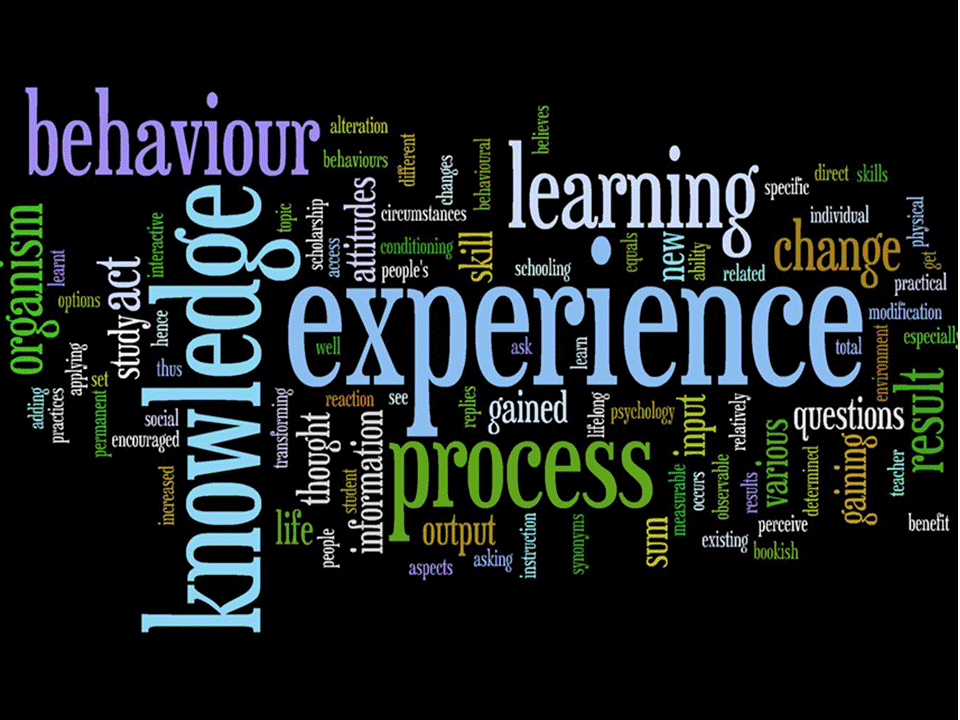
      I've been messing around with Wordle. In particular I wanted to assemble a number of definitions of "learning" and to explore their similarities and differences in emphasis. and it does a fantastic job of that;


      It occurs to me that it provides a very easy tool for the quick analysis of qualitative data such as transcripts of interviews. See here, too for its use in a similar way to reveal two different positions in a political debate. I'm sure others have got there first, but it seems to have plenty of potential...

      16 January 2010

      On the demise of another craft

      I feel for this story. I have groped and fumbled round darkrooms, and loaded developing tanks under bedclothes and backed off from developing colour film doubting whether I could maintain the required temperature tolerances. I was never much good at it, so I really respect the skills of the masters (and mistresses) of the craft.

      So let's celebrate the skill, and even mourn its passing, but its time is past, and PhotoShop and its competitors have the field. Get over it and move on!

      But there is one difference, and it matters from a training point of view.

      A year or so ago I asked Antonio (real first name) after a session I observed on his photography course, why the course still included "old-fashioned" analogue techniques (using film, and developing and printing it). Because, he told me, of their irreversibility. If you can "undo" and start again, and again, and again, there is little incentive to learn (as opposed just to try again).

      So: to what extent does the cost of failure contribute to skill learning?

      And--cost to whom? Sponsor, "provider", student...? what difference does that make?

      15 January 2010

      On living in the future

      Excellent site; a children's book from 1972 showing what everyday life would be like in 2010, with comments. Some predictions quite odd, but others very prescient. H/t Boing Boing and the Browser.

      11 January 2010

      On the education of nurses (in the USA) --and parallels

      I know that some readers are in nurse education, so you might be interested in this new report from the Carnegie Foundation for the Advancement of Teaching, in the USA [link from post title]. It parallels in some respects the plan for nursing to become an all-graduate profession in England by 2013. That proposal has been met with some scepticism in the UK.

      It does seem that what Etzioni (1969) called the "semi-professions" have been making strenuous efforts in the latter half of the last century to enhance their status. As the citation below shows, he identified teachers, nurses and social workers as the main semi-professions, although since he was writing there are many more candidate occupations. I used to teach social workers, and more recently I have been teaching teachers, among whom have been nurses taking what the Nursing and Midwifery Council terms a "Recordable Teaching Qualification"--so I have a certain amount of knowledge in the area.

      When I first taught in a primary school in the early sixties, some of my colleagues had only one year's training, or indeed higher education; they were known as "Emergency Trained" in a scheme developed in the aftermath of WW2 particularly to replace the large numbers of male teachers lost to the occupation. The norm was two years (although there was one teacher on the staff, apart from myself, who was quite untrained). Graduates did not have to be trained.

      The first social work course I taught on was just a year long, with no specific entry requirements other than at least six months experience in residential child care. When I moved on from social work education, the Diploma in Social Work was just two years long, but in practice only taken by mature people (in age, at least) with some prior experience. The standard qualification has only been an undergraduate degree for a few years. Strangely at my former institution it is a Bachelor of Science award. Recently, (December 2009) the Social Work Task Force has reported, recommending the equivalent of a probationary year for newly-qualified staff, with extra support and supervision and the estbalishment of a National College for Social Work (presumably to replace the National Institute for Social Work which was closed in 2003...)

      And nursing is now either a Diploma or Degree qualified profession, in both cases following a three year course. It moved from being work-based training with study blocks to coming under the auspices of universities in a programme called "Project 2000" from 1992 onwards. This was itself influenced by practice in the USA.

      So what?

      The first point is that as the fully-qualified staff have moved up the professional scale in each occupation, much of what they used to do has been taken over by lowlier and less-trained people. So much of the routine activity in nursing (and crucially the long-term and continuing patient contact) is now undertaken by Health Care Assistants, whose basic qualification is at National Qualifications Framework (NQF) level 3. Classroom Assistants have become increasingly important in schools, they may have minimal training or be relatively well-qualified with a Foundation Degree; from being primarily concerned to help children with special educational needs, their roles have become broader to the extent that the may be asked to "deliver" lessons using material prepared by a "proper" teacher. And social work has always relied heavily on an army of poorly-paid residential or domiciliary care assistants, nursery nurses and others often with very basic National Vocational Qualifications. So a caste division is established.

      Of course, the fully-qualified staff cease to be direct practitioners--they become supervisors and managers. And because of the  institutional anxiety engendered by the fact that direct "user" contact is increasingly undertaken by under-qualified staff, the quality assurance procedures have to be tightened which means that the qualified staff spend even more time in their offices dealing with paperwork... There is also a view which may or may not be legitimate that the new generations of highly-qualified staff are coming to see direct contact, particularly of a routine and even menial kind, as "beneath them".

      And... Many commentators have made the point that raising the bar for the final qualification is likely to entail raising entry requirements and thereby excluding  many potential candidates from under-represented groups. I'm not entirely convinced by this argument. Further and higher education institutions are in practice going out of their way to create ladders through sub- and para-professional qualifications to full professional recognition. And--purely on the basis of prejudicial respect for dozens of people I have had the privilege of guiding to that recognition--I need actively to be persuaded that people following this route are not the very best all-round practitioners in their fields. Their commitment, stamina, and practical experience (tempered perhaps by their toleration of being taught by prats like me--putting up with that is not  a commendation)! ...does not merely add--it multiplies their practice wisdom.

      But. From a different angle--

      What is happening to those left behind?

      Policies of social mobility which encourage able people to transcend their origins are great. Up to a point...
      • in a norm-referenced world, for everything which goes up, something must go down.

      • Gramsci (1971) (Italian marxist theorist imprisoned by Mussolini) was concerned about the development of "organic intellectuals" among the working class. Roughly, "traditional intellectuals" are people who think of themselves as such; organic intellectuals are people who undertake intellectual work without recognising themselves or being recognised by others. Gramsci argued that organic intllectuals were a by-product creation of the ruling classes, but that they also had counterparts "embedded" as we should now say within the working classes, in voluntary and community groups, in unions, in churches (not sure where he stood on religion) and families. In his view it was vital that they be enlisted to lead the revolutionary struggle.

      • The problem from this perspective is of course that educationally-promoted social mobility may be seen as "creaming off" the working-class organic intellectuals, thereby leaving working-class communities leaderless and even more disenfranchised than before; hence, it may be argued, "sink estates" and so-called "broken Britain" (and perhaps vulnerability to right-wing demagoguery), as opposed to Hoggart's account of pre-WW2 working-class life in "The Uses of Literacy" (1957).

      • The rise of the semi-professions fits into this argument because of their accessibility to aspirants.
      Push the argument further (perhaps too far?) and it suggests that raising the bar for the semi-professions does not enhance but undermines not only the quality of the service they offer, but also the quality of life of a large proportion of the population...

      Discuss!

        Etzioni, A. (1969) The Semi-professions and their Organisation: Teachers, Nurses and Social Workers, New York: Free Press


        Hoggart, R (1957) The Uses of Literacy; Aspects of Working Class Life London; Chatto and Windus

        08 January 2010

        On textbooks

        As you know, I am about to start teaching a module which I last taught (conforming--or not--to a different set of guidelines/requirements/regulations/standards, but we can ignore them) ...I last taught two years ago.

        But I have actually been planning this run of the module, partly because I do suppose I have to pretend to pay some attention to the new standards (which, although still meaningless, are actually less restrictive than the old ones). In fact the specified outcomes for the module are so woolly that the only guidance is contained in the shibboleth of "inclusivity".

        (My unregenerate dark side still thinks that this is a euphemism for "dumbing down to meet unrealistic and arbitrary government targets", but really I do know better. Honest!)

        One practical manifestation of this exercise is that I have been obliged actually to open the textbooks which we recommend to the students. (Only if you recommend them do you get to keep the inspection copies of the latest editions which the publishers so obligingly send at fairly regular intervals. It's quite an ingenious Catch-22. The students and/or the library will buy the latest edition anyway [although not necessarily of this particular textbook which is one of many very similar offerings]. Either, we can recommend it so as to get a free copy, or we have to buy it in order to understand what the students are referring to.

        ...Or of course ignore the textbooks altogether apart from commenting adversely on scatter-gun arbitrary quotations from them which add nothing to assessed work other than demonstrating that the student has ritually bowed before the Supposed Authority sufficiently to extract a few irrelevant words...


        Sorry for the splenetic rant. (I'm jealous, really. I want to be invited to write the definitive textbook. As if.) There is a more serious point to this post:


        It is about what "textbooks" do to their subject-matter. Probably under pressure from editors and publishers, authors have to contort and distort their topics to fit published syllabi or standards, and the effects of doing so are wholly pernicious;
        • they "send a message" that reading and expressing an interest in this material for its own sake is improbable or even impossible--it has to be packaged as stuff to be "covered" in the interests of getting a qualification. In other words, it positively encourages surface learning, while at the same time doubtless inveighing against it. I am a devotee of popular science books. Granted, they don't (always) go into the (technically) difficult stuff and steer clear of maths (apparently someone told Stephen Hawking that each equation in his book would halve its readership) They start from the assumption that their subject is inherently fascinating, and they (authors, agents, publishers...) will be happy if they manage to ...er, make money. But in this market, for once, making money is a good proxy for a good product. Not so in the textbook market which is artificially created by examination boards and accreditation bodies...
        • they regurgitate mainstream and conventional wisdom, with little report of dissenting voices and debate; simply because anodyne regurgitation (is that an oxymoron?) gets people through assessments. Evidence? Follow the treatment of a controversial topic (say, learning styles) through several editions of a textbook and see how it shifts to accommodate the conventional wisdom... 
        • they package ideas within the discourse of their avowed subject matter; I remember "Psychology for Teachers" and "Psychology for Social Workers". The selection of topics is not so much the problem--it is the stipulative rhetoric with which the material is pushed out.
        Or am I just too much of an idealistic academic? Is it not simply trivial in the overall scheme of things?

          On the consequences of early specialisation

          Michael Ruse has a great debatable point here.

          05 January 2010

          On (probably) the last time round...

          ...and the first time.

          I'm teaching a module this term both for the first time, because the arbitrary professional validation requirements have changed---and probably for the last time, because I am supposed to be retired and there is certain to be a clamp-down on the part-time staff budget in the light of the recent swingeing cuts.

          When I was contemplating retirement a few years ago, I continually reassured myself that if I could just teach this module one more time, I would really get it right. This may be the "one more time". But the aspiration embodied at least two fallacies;
          • that it was all up (or "down"--it means the same thing) to me as the teacher. It's the myth of teaching as performance. It's a small part of the reality, but only a small part. There is no fixed "performance" standard. But there is a standard of fit with  a particular student group.
          • and even more that it was my self-assessment that mattered. Teaching is about bringing about learning: 
          • A man that looks on glass, On it may stay his eye, Or, if he pleaseth, through it pass, And then the heav'n espy.
            (George Herbert, 1633, The Elixir)
            Teaching is the glass, learning the heav'n.
            More prosaically, keep your eye on the ball--not the bat.
          I'll be re-visiting some of the issues raised by this module, no doubt.

          03 January 2010

          On identifying a fundamental problem

          OK, this is a little more explicitly political than my usual posts, but --allowing no doubt for the cherry-picked anecdotal "evidence" verging probably on urban myths, which I have to see behind every tree in the media nowadays*-- Jenni Russell's diagnosis of what has become of Labour's naive interventionism does seem spot on.But even she does not see Cameronism as a panacea...

          * Do read Davies N (2009) Flat Earth News London: Vintage which is an enormously eye-opening expose of the present state of journalism (or "churnalism" as he calls it, and I suspect he's a bit naive about drugs policy, but even so...)

          29 December 2009

          On postponing pleasure

          As we contemplate New Year's Resolutions... The link is about one it ought to be easy to keep; enjoy yourself--now! But it probably won't be.

          The other side of the coin is a phone-in I heard this lunch-time while driving; it's full of wild generalisations and stereotyping as these things always are, but it addresses the question why the UK's children are among the most miserable in the developed world. One reason may be that they tend to be spoilt, and they are no longer taught "deferred gratification", or precisely that postponement of pleasure the NY Times article bemoans...

          28 December 2009

          On gifts

          I know I am a difficult person to buy presents for, generally because there is rarely anything I want. Last year I managed to persuade family members to buy a goat or some other livestock on my behalf, for somewhere in the developing world, but they did not take to the idea again.

          Money and tokens are last resorts. They send a message not only that "I give up on thinking what to get for you" but also "you are worth precisely £10, or whatever." At least with an actual object, the message of the financial value is mitigated by the thought, the empathic act of thinking what someone would enjoy receiving.

          I rarely get this right, myself. For once I did this year, giving one grown-up son a mini-food-processor. He lives alone buthe is an enthusiastic cook. The next day he turned up extolling its virtues and accompanied by small bowls of dips and relishes all based on chopped raw brussels sprouts combined with a variety of oils, herbs, spices and other vegetables in a variety of exotic and very tasty combinations; he had spent the entire previous evening experimenting.

          I received some presents yesterday, including two books from the "Humour" section of the bookshop, which it is unlikely that I shall ever read--the usual curmudgeonly rants about present-day life and culture which can be fun for a few pages if one's own prejudices coincide with those of the author, but which quickly pall. Giving books needs to take into account that they require the investment of time in reading them.

          In the bookshop today I looked at the section they had come from, and I realised that practically all of that section, and the cookery books, and the celebrity memoirs at the very least, was taken up by books which are produced in order to be given, rather than read. And walking home I passed a new shop, which advertised its wares as "cards and gifts". Of course anything can be a gift (something else I received yesterday was two cans of kippers--but I do like kippers), but the suitability for "gifting" (and probably re-gifting and re-re-gifting for ever) has taken over from the intrinsic value of the object. Indeed in the case of many objects such as books, it is important that they not be used, and indeed that any packaging not be opened if they are to remain suitable gifts.

          This is not new, of course. Bronislaw Malinowski documented the Kula Ring exchange among the inhabitants of the Trobriand Islands in the South Pacific in "Argonauts of the Western Pacific" (1922) (see also here) in which the continual exchange of the same goods serves to structure and maintain social relations between the inhabitants of scattered islands.

          Come to think of it, for many of us this pattern may make more sense that to concentrate on the utility of gifts...  It's one of those issues where process is more important than content.

          See also Mauss M (1954) The Gift; forms and functions of exchange in archaic societies London; Routledge and Kegan Paul (preview available here)

          24 December 2009

          On Christmas

          You can track Santa's progress over Christmas here (background feature here.)

          Here's your seasonal Reading List 

          Very best wishes for Christmas and 2010!

          21 December 2009

          On "Avatar" (no--I haven't seen it)

          This link is about third-hand. And given that I have not seen the film, and may well not bother--I still haven't seen Titanic--why am I commenting? I haven't tracked back to the sources of the linked post either.

          Partly because third-hand blog-posts with their accretion of comments are a cultural artefact in their own right...

          But also because the quoted piece in the linked post struck a nerve with me.
            In the late 1960s and early 70s, I was involved with, and for a year lived in, a community house in Moss Side in Manchester. 
            (Google it and take your pick of the references: I've just discovered that the Hideaway youth club where I peripherally and ineffectually  volunteered booked a band called the CrossBeats in March 1967 just a couple of weeks before they played an obscure venue called the Cavern Club in Liverpool; they were booked by a certain Rose Drummond, who later married my housemate in 1970, Joe Burgess... and that was the first time I had heard of a mixed-race marriage, nine years before my own.) Wow, what you can turn up in a few moments!
          Eventually, the house was compulsorily purchased and demolished, and (most of) us graduate do-gooders moved away to our middle-class destinies, basking in the moral and political glow of our transitory pretence of identification with "the disadvantaged". I spoke to a real resident of the area as we reviewed the project. He was very kind and appreciative about our well-meaning contributions to the area, but as best I can recall he said something to the effect that;
          We do appreciate all you and your companions have done... but don't kid yourselves that you know what it is like to live in Moss Side, because you did it by choice. You have somewhere else to go, if you choose. We haven't.

          On learning styles again

          "The contrast between the enormous popularity of the learning-styles approach within education and the lack of credible evidence for its utility is, in our opinion, striking and disturbing. If classification of students’ learning styles has practical utility, it remains to be demonstrated."
          [Pashler H, McDaniel M, Rohrer D and Bjork R (2008) "Learning Styles; concepts and evidence" Psychological Science in the Public Interest vol. 9 no.3; available on-line at http://www.psychologicalscience.org/journals/pspi/PSPI_9_3.pdf accessed 21 December 2009]

          The message is also getting out over the pond! Useful bibliography, too.

          19 December 2009

          On a new kind of university...

          Overheard at coffee yesterday; the three aspects of an academic's job are research, teaching and administration. Traditionally, universities are regarded as research- or teaching-intensive. We are  breaking new ground as the world's first administration-intensive university.

          17 December 2009

          On a counsel of despair

          Sean has done me the honour of a point-by-point rebuttal of some earlier points of mine; do read the linked post. He makes some very good points, and I don't think it's a good idea to get into an old-fashioned argument about them, but better to set them out before you and encourage anyone out there to respond to either or both of us.

          Having said that :-)
          • My view of the both theoretical and practical impossibility of a universal model/template/method for teaching is not a counsel of despair; it's an invitation to relish a dance... Yes, I know it is task-focused and chemical engineering is hard (in several senses), but the dance is still there in the engagement and response with students' understanding (or failure to understand), and accumulating a body of practice wisdom about how to engage with both of those conditions. As Sean refers to his engineering expertise, I venture to suggest that it is not merely that teaching (and its admittedly patchy theory) does not live up to his positivist and pragmatic paradigm--but nor does his engineering practice, either (or that of any other expert).

          • And "2. Why do values and feelings matter in the context of engineering education?" You go with the "engineering is value-free" line here. I do not disagree, but the point relates to the human encounter which is  critical to teaching and learning, rather than the subject matter. Learning always involves feelings; boredom, fascination, frustration, achievement... and many more. They are not the prerogative of soft, humanistic topics. "I just can't get my head around these equations!" is an expression of feelings, and how a teahcer engages with it--ridicule failure and humiliate to motivate, or take the problem seriously and explore where the blockages are--are expressions of values in teaching. And so is the cost-benefit analysis a teacher engages in when deciding how much time to spend on helping an obtuse student versus getting through the syllabus. Values are not something we impose on our practice; they are implicit in it whether we acknowledge them or not.
          Come on in, the water's fine! And the exercise will do you good!

          16 December 2009

          On presents to lay down...

          This season, I have two great-nieces and a great nephew, as well as a step-granddaughter. The latter is no problem or indeed challenge in respect of presents; she is old enough to write a list, and we are close enough to her to respond directly (which is not, for the record, giving her exactly what she asks for).

          But being at one remove offers opportunities. To "lay down" gifts for future enjoyment. In times past it might have been the beginning of a wine cellar. A generation ago, I typically gave the current "Whitaker's Almanack" as a record of the year of a child's birth, and perhaps as the foundation of a library.

          Things have moved on. In particular, the net has largely marginalised that kind of contemporary/historical record. (What it cannot overtake, of course, are the casual, routine values/prejudices which are embodied in the reporting of the day, but the blogosphere more than makes up for that.

          Last year, Gombrich's wonderful "A Little History of the World" had just been published in English, about 80-odd years late. It's too old for the children now, of course, but it will be there for them when they are ready. Any ideas about this year's equivalent?

          10 December 2009

          On getting published

          I don't generally have a high opinion of what passes for scholarly literature in the education journals, although it is mostly unread and therefore in Douglas Adams' words "generally harmless". But when I read the linked abstract in what appears to be a respectable medical journal (at least, one listed on PubMed) I get worried.

          Hat-tip to the National Center for Biomedical Information's ROFL blog (stands for Rolling On the Floor Laughing in txt-spk) for the link--and something of an explanation, here.

          On evidence-based practice

          In his blog (starting I think with this post) Brian Elsner is exploring the direct application of Marzano's principles of effective teaching based on his meta-analysis. Well worth following.

          If you've no idea what all this is about, see here for a general orientation.

          09 December 2009

          On elegance

          That's Design.

          08 December 2009

          On an ingenious approach to marking assignments

          Steve Hill of Southampton Solent University has been experimenting with Camtasia, a screen recording package which also takes audio, as a means of recording his spoken comments on students' work, which he can then send to them.
          Students submit assignments electronically using our Moodle-based VLE. I then get a student’s Word file on screen and edit it, whilst simultaneously giving a live commentary on the changes that I’m making. This is like giving a student their own personal tutorial.
          Sounds like an excellent idea!

          05 December 2009

          On asserting "interestingness"

          An epiphany while watching QI. An inviolable rule for teachers; never tell your class/audience "this is really interesting" before expounding on something.

          It's a great example of two levels of communication at odds; a variation on the double-bind. If you have to tell them it is interesting, it isn't. Many years ago, a friend of mine was much given to this mistake, and it is only now that I realise that although some of what he said was indeed interesting, this "paradoxical operator" (hey--that's a good phrase--you read it here first) was always heard as the opposite, "Get ready for some boring stuff incoming!"

          It is however OK to seek confirmation afterwards.

          Isn't that interesting?

          04 December 2009

          On revisiting stuff

          I had lunch today with a friend, who to my amazement was not familiar with TED talks. So although I have posted the link before, a couple of years ago I think, here's a taster... (But I do wish he didn't laugh at his own jokes.)

          02 December 2009

          On insisting on belief

          Uncannily, this links to the previous post.

          It appears that there is a resurgence of Political Correctness on some US campuses, and the linked article is getting hot under the collar about curriculum changes at the University of Minnesota's College of Education and Human Development.

          A campaigning group called the Foundation for Individual Rights in Education claims;
          "If the Race, Culture, Class, and Gender Task Group achieves its stated goals, the result will be political and ideological screening of applicants, remedial re-education for those with the 'wrong' views and values, [and] withholding of degrees from those upon whom the university's political re-education efforts proved ineffective."
          My reading of the University's web presence is that the above is a gross over-statement, but I don't want to get into that fray.

          There's another take on the story here.

          Instead, I do want to engage with the very fraught question, in some professional education programmes, of the assessment of student values.
          • these are often represented by beliefs --in the sense of assent to propositions--as just-about-assessable proxies for underlying value-commitments. 
          (I'm currently reading Armstrong, 2009; one of her major arguments is the distinction between two senses of "belief", which I had hitherto believed originated with Buber but she shows has a much more venerable provenance, between pistis [crudely "commitment"] and emunah ["assent"]. She argues that the ascendancy of the latter sense is an Enlightenment phenomenon.)

          Values are at the lowest level commitments to tolerating some inconvenience or hassle to act in a certain way. By extension, lack of preparedness to tolerate the hassle suggests that an opposing value may be inferred. (This framework I concede is very simplistic, but stick with me.)

          Action is the gold standard by which values may be assessed. "Espousal" (Argyris and Schon, 1978) is not enough. But action demands an opportunity to act, and happily --and appropriately-- most practice opportunities in professional education programmes do not expose students to those demands.

          So we are forced back on proxies; simulations and case-studies. These suffer from problems at both ends of the explicit-implicit spectrum.
          • Practitioners tend to favour explicit scenarios. "What would you do if...?"
            • Of course, this signals fairly clearly what you are supposed to do, which is usually not a matter of exposing one's values so much as one's familiarity with institutional procedures (when in doubt, ask the boss).

          • Teachers favour more subtle cases where there is an ethical/professional problem lurking in a seemingly innocuous case. (Confession: I really enjoy devising these.) But the convolutions of building the scenario may be so byzantine that we lose touch with reality.

            • [I once built a fantastic scenario around an obsessed persecuting ex-partner to pose questions --OK, legal rather than ethical-- for a class, only to be demolished by a participant who pointed out that the legal dispute was a civil rather than criminal matter and so all the subsequent argument was moot...  At last I may have found a way to recover some worth from those moments of utter humiliation.] 
          Several years ago, one of our external examiners (for the social work course on which I then taught) observed in the meeting of the examination board that although it was clear that the students had been taught "anti-racist and anti-discriminatory practice" on the course, they did not make any use of their learning in their assessed work. [He had a vested interest, incidentally, having at the time recently written a book on the subject... I'm sure that this had nothing to do with his remarks.]

          Indeed they didn't. Frankly they had more sense. They saw through the whole charade, as an exercise in compliance by their pusillanimous tutors. They had indeed learned from all the teaching, but they had learned simply how to play the game and profess assent to the hegemonic creed. They knew very well, in short, that what you say and what you do are quite different things. As does every grown-up person.

          Yes, the values you practise are utterly critical to your work. But the last thing you want is to train people to be hypocrites. I have major reservations about the Minnesota programme, but as befits this blog they are principally about its educational assumptions rather than its political aspirations.

          Oh, and if you are not craft-competent as a teacher, everything else goes out of the window.


          But the argument has drifted a little, from the principle to the practice.
          • I'm training Anglican ordinands (hypothetically). It is (or used to be; I don't claim to be up to date on this) part of the contract that in order to be ordained they had to profess assent to the 39 articles of faith of that church. The requirement is notoriously much fudged, but it is clear and up-front and, critically, relevant. Presumably, if you don't want to sign up, you don't want the role...

          • I'm equally hypothetically selecting a candidate for a political party. They will have to be seen to espouse the part manifesto if the party is to endorse them; but it is as much the party's choice as theirs... And do they have to believe/accept the manifesto? Or just keep their reservations to themselves?

          • I'm training and of course assessing student social workers (not entirely hypothetical--I did actually do that for a couple of decades. See the point above about the external examiner's remarks.) It clearly matters what they do, but what they believe...? The PC argument is that "going through the motions in compliance with departmental requirements" is not enough. Only the practitioner who has taken to heart the transformational insights of anti-racism (see here) can proactively detect institutional discrimination before the formal procedures pick it up (let's leave aside the unfortunate side-issue that unwillingness to confront the cultural practices of minority groups has almost certainly lead to the deaths of a number of children and the suffering of many more--not to mention vulnerable adults...).
          I can see the point of the Minnesota initiative. Indeed, some of the material which informed this paper was clearly coming from a similar base. But is it legitimate?