27 February 2010
On a defence of plagiarism
At the risk of becoming incestuous, because Jim Hamlyn quotes me approvingly (thanks, Jim), the link is to a very thoughtful and nuanced discussion of plagiarism and the standard academic "zero-tolerance" approach.


22 February 2010
On libel reform in the UK
(Sorry--if you are not a UK citizen [well, we're not "citizens" actually, but "subjects" of the monarch, but you get the idea] I don't think you can join this party. But not being a British "subject" does not excuse you from the pernicious influence of these laws...)
You may know that the UK is the "libel capital of the world". It is the court system of choice for anyone wishing to silence critics or dissent, no matter how well founded and almost regardless of its UK connections. Libel awards are stupidly high, and costs astronomical, so few organisations and almost no individuals can afford to defend themselves.
Tomorrow, the British Chiropractic Association's suit against the science writer Simon Singh goes to appeal, and on Wednesday the House of Commons' Culture, Media and Sport Select Committee will release a report that, amongst other issues, will look at the impact of English libel law on free expression.
So this is a critical week to make your views known; go to http://www.libelreform.org/ and read the arguments and sign (or not, depending on your judgement; and it is conceivable that there are sites arguing the opposite case. If so, feel free to comment--I won't block any fair argument.)
(This is not a party political issue in any sense.)
18 February 2010
On norm-referenced grading
A fascinating insight into how a US professor grades forty essays, on a norm-referenced basis. (If you're not familiar with that term, have a look here, with a more opinionated piece here.) Apart from her initial remakrs about approaching the drafts like a copy-editor, I have no idea what actual criteria she is using to make her judgements.
I referred here to another columnist's approach to grading, which seems to be based on the amount of work a student submits rather than on its quality;
I referred here to another columnist's approach to grading, which seems to be based on the amount of work a student submits rather than on its quality;
"...you made the deadlines -- which is what I expect from everyone -- and you handed in the assignments -- which is also what I expect. That level of work secures students a "C" because that's what we call "meeting the minimum requirements" and in no case would that snag anybody an automatic A."I may grumble about subject benchmarks and the generally dead hand of the Quality Assurance Agency on higher education in the UK--and of course the system conspicuously fails to deliver the consistency it claims--but at least the insistence on criterion-referenced assessment does mean that students and colleagues should know more clearly where they stand than in what appears from a distance to be a highly arbitrary world across the pond.
17 February 2010
On virtual portals or ramparts
Last week P and I had lunch with R, a former student who is now working at the Open University. She was seeking our assistance in trialling a social networking package based on sharing teaching resources, which of course we were happy to support. ("Support" because I'm retired and P has no authority to commit the university to such a collaboration... Yes, I know...)
Today, this came up again. And I had to think hard to remember what the project offered. It certainly was nothing I could imagine actively seeking. It joins a series of repositories and resources with similar aspirations. I'm sure that much of what they contain is brilliant, but it is more trouble to find and access it than it is to to re-invent it from scratch.
A few thoughts;
But the linked article is about the hard-core e-addicts. "Second Life" is probably the most egregious example of futile expenditure of time, effort and money to achieve very little. I have sat through several presentations and demo. sessions by the true believers. I do remember one in which the principal avatar was a character whose head was a flaming skull--very conducive to rigorous and dispassionate academic debate. Then there was a crude simulation of Mendelian genetics at about primary-school level... And the much better simulation of paramedic practice scenarios. That was quite vivid, but I know from sitting in on such teaching that the AV bells and whistles can't hold a candle to the timing (in particular) of an experienced practitioner overseeing merely paper-based problem-based-learning.
The very fact that I write a blog, and have two web-sites, and set up a blog for each module I teach indicates that I am not a total luddite. But e-learning has a very long way to go, and so it should. It's as much an obstacle as a opportunity to learning, even for the "millennial" generation.
Today, this came up again. And I had to think hard to remember what the project offered. It certainly was nothing I could imagine actively seeking. It joins a series of repositories and resources with similar aspirations. I'm sure that much of what they contain is brilliant, but it is more trouble to find and access it than it is to to re-invent it from scratch.
A few thoughts;
- Do we know how many people really use these resources, as a proportion of those teaching these topics? If I were to go by all the stuff I read in the blogosphere, absolutely everyone is on Facebook and Twitter all day. I heard on the radio today that "the average person" spends 55 minutes on social networking on their mobile each day. Rubbish! Have these people never heard of sampling?
- Where is the disinterested research on the added value of e-learning, other than in dedicated distance learning programmes? This time last year I did an on-line (of course) course on on-line tutoring, which was full of assertions about how wonderful e-learning was. And full of passionate conviction on the part of people who have a vested interest in it. It was very well done; the design, implementation and on-line support were state of the art. It took six weeks to learn much less than I would have picked up in an hour face to face. (That is just my opinion--but the other side has little more evidence...)
- Who has time to go looking for other people's stuff, and then re-configuring it to suit their own teaching, and re-configuring their own teaching to fit round it? It's quicker to develop it for oneself.
But the linked article is about the hard-core e-addicts. "Second Life" is probably the most egregious example of futile expenditure of time, effort and money to achieve very little. I have sat through several presentations and demo. sessions by the true believers. I do remember one in which the principal avatar was a character whose head was a flaming skull--very conducive to rigorous and dispassionate academic debate. Then there was a crude simulation of Mendelian genetics at about primary-school level... And the much better simulation of paramedic practice scenarios. That was quite vivid, but I know from sitting in on such teaching that the AV bells and whistles can't hold a candle to the timing (in particular) of an experienced practitioner overseeing merely paper-based problem-based-learning.
The very fact that I write a blog, and have two web-sites, and set up a blog for each module I teach indicates that I am not a total luddite. But e-learning has a very long way to go, and so it should. It's as much an obstacle as a opportunity to learning, even for the "millennial" generation.
12 February 2010
On acquiring craft skills
I just posted this to a blog for a specific taught module (it's great to be so opportunistic--the programme finished less than half an hour ago), but it may be of wider interest. Apologies if you are overseas and not able to access the BBC iPlayer link--or if you arrive too late at the party and it has expired.
Do watch this delightful programme for its own sake. OK--discount the "reality-TV" artificial competitiveness and deadlines.
But. Let's discuss what it says about the acquisition of craft (a.k.a. psychomotor) skills, about the role of sheer repetitive practice, about whether "reflection" matters in doing this, about the importance of constructive and encouraging feedback (Sarah is a living case-study), the zone of proximal development, and in the final minutes the issue of transformative learning.
And all communicated through a story.
11 February 2010
On Pepys' diary
Simply the most perfect RSS feed imaginable! A parallel, entry by entry, version of the most famous diary in the world, with superb rollover annotations. Brilliant.
And strangely absorbing, as opposed to, say George Orwell's diary, which is pedestrian, flat and deadly boring.
Incidentally, neither would qualify as "reflective", would they?
And strangely absorbing, as opposed to, say George Orwell's diary, which is pedestrian, flat and deadly boring.
Incidentally, neither would qualify as "reflective", would they?
08 February 2010
Maintenance information
Sorry there's no content here just now--following on from the need to relocate to Blogger's servers, the good news is the search box re-appeared in the navigation bar. The bad news is that it doesn't work. It appears that I am not the only person to experience this problem and Blogger seems to have failed to fix it for some time.
So I have inserted a Google Custom Search box in the side-bar on the right, just above "Previous Posts"; this will search not only this blog, but the "Doceo" and "Learningandteaching.info" sites as well, so it should actually be more useful. Please let me know if you have any problems with it.
So I have inserted a Google Custom Search box in the side-bar on the right, just above "Previous Posts"; this will search not only this blog, but the "Doceo" and "Learningandteaching.info" sites as well, so it should actually be more useful. Please let me know if you have any problems with it.
07 February 2010
On on-line frustration and anger and the learning experience...
An odd coincidence. As I was walking the dog this morning, I was trying to reconstruct what I was doing this time last year, and thinking about a short on-line course I had undertaken on on-line tutoring. In particular I thought about how frustrated I had been by the process, and how petulant I rapidly became as a result, and how I became a tutor's worst nightmare. I blogged my reflections; they are mostly to be found here (start at the bottom of the page, of course).
And then I checked the blog feeds--and there was the linked post, which described a very similar experience to my own of a year ago, although the context was slightly different.
It occurred to me that "setting ground rules"--the exercise which so annoyed Jim--was perhaps necessary precisely because of the frustrating lack of capacity of this limited-channel medium of on-line discussion to which people can so readily respond with the kind of adolescent tantrum I barely managed to contain but which Jim handled so much more elegantly. We have all doubtless encountered examples of immoderate on-line offence and defensive rage, which flare up so much more readily in this strictly mediated environment than they do (in my experience, at least) in real life.
I have every sympathy with his notion of a "social gift" offering a superior approach to the maintenance of order*, but... I can't remember whether my on-line course we covered ground-rules. I've just looked at the (conspicuously useless) recommended text to check and they do not appear in the index at least. I do address them on the teaching site.
- But... Contextualise. Both our on-line learning sessions were ultimately about us doing to others what was now being done to us. Both were based on the premise that "this present group is mature and civilised and won't need much external 'control'", alongside, "that will not always be the case." That seems fair enough, on the basis of experience.
- So: on the on-line course;
- Task oriented communication is "privileged".
- Process communication is more difficult to manage. Instant spontaneous feedback about how an intervention is "taken" is not possible; nuanced feedback (the lift of an eyebrow signifying "did you really mean to say what I just heard you say?") takes ages and is almost always misunderstood.
- Reduced to impoverished communication, it does make sense to be explicit about the rules; as long as the reasons are clear. Yes, it is second best, but compared with tenth-best, that's good...
06 February 2010
A new address
In response to various technical changes instituted by Blogger, I have changed the hosting arrangements for this blog. I really don't have much of a clue about how all this works, and I hope the RSS feed, etc. continue uninterrupted, but do let me know if you experience any problems.
The good news is that the search box is back, on the navbar at the top of the page.
The good news is that the search box is back, on the navbar at the top of the page.
On "refuting"
"I refute (an allegation)"
Can one do that? Surely "refuting" is the result of some judicial process, rather than a personal claim? I may reject or deny or contest an allegation, but some other body has to refute it?
(This post is all my own work. I deliberately consulted no external sources on this definition; that is the point.)
On responsibility for climate change
There's another survey tonight whipping up a fuss about the declining proportion of the population believing in "man-made" (sic) climate change.
It doesn't matter! IF it is happening, it is futile to allocate "blame". There is an implicit assumption that if "we" caused it, "we" can sort it out.
Not so.
It doesn't matter! IF it is happening, it is futile to allocate "blame". There is an implicit assumption that if "we" caused it, "we" can sort it out.
Not so.
On a thoughtftul consideration of what constitutes plagiarism
No--I'm not posting this (merely) because I am quoted approvingly. Jim Hamlyn explores what "plagiarism" means in the context of a discipline in which (critically, implicit) allusion and reference matter a lot, and provides much food for thought.
01 February 2010
On the point of teaching
An excellent piece on being able to see the wood for the trees in relation to teaching;
In discussions of “effective” teaching, we often hear about the “objectives” that teachers should spell out and repeat, the “learning styles” they should target, the “engagement” they should guarantee at every moment, and the constant encouragement and praise they should provide—all in the interest of raising test scores. The D.C. public schools IMPACT (the teacher assessment system for D.C. public schools) awards points to teachers who implement such practices; Teach For America addresses some of them in its forthcoming book.
Except for the misguided notion of targeting learning styles, none of these techniques is wrong in itself. But together they raise a barrier. Instead of bringing the subject closer to the students, this heap of tools proclaims: “No entrance! The subject is too hard without spelled-out skills, too boring without adornment, and too frustrating without pep talks and cheers!”
Worse still, such techniques take precedence over the lesson’s content. A literature teacher is evaluated not for her presentation of specific poems, but for stating the objectives, keeping all students “on task,” reminding them about the relation between hard work and success, using visuals and manipulatives, and, ultimately, raising the scores. It matters little, in such a system, whether the poem is excellent or trivial, what kind of insight the teacher brings, or what the students might take into their lives."My sentiments exactly, as I've note before on the blog and on the site. And thanks to Sheffner for saving me the trouble of looking up those urls for myself!
27 January 2010
On evidence-based practice
The linked article examines what the Teach for America programme claims actually makes for good teachers and teaching. Among many other points;
(2) And so much for the new Master's in Teaching and Learning.
"For years, Teach for America also selected for something called “constant learning.” As Farr and others had noticed, great teachers tended to reflect on their performance and adapt accordingly. So people who tend to be self-aware might be a good bet. “It’s a perfectly reasonable hypothesis,” Ayotte-Hoeltzel says.
But in 2003, the admissions staff looked at the data and discovered that reflectiveness did not seem to matter (1) either. Or more accurately, trying to predict reflectiveness in the hiring process did not work.
What did predict success, interestingly, was a history of perseverance—not just an attitude, but a track record. In the interview process, Teach for America now asks applicants to talk about overcoming challenges in their lives—and ranks their perseverance based on their answers. Angela Lee Duckworth, an assistant professor of psychology at the University of Pennsylvania, and her colleagues have actually quantified the value of perseverance. In a study published in TheJournal of Positive Psychology in November 2009, they evaluated 390 Teach for America instructors before and after a year of teaching. Those who initially scored high for “grit”—defined as perseverance and a passion for long-term goals, and measured using a short multiple-choice test—were 31 percent more likely than their less gritty peers to spur academic growth in their students. Gritty people, the theory goes, work harder and stay committed to their goals longer. (Grit also predicts retention of cadets at West Point, Duckworth has found.)
But another trait seemed to matter even more. Teachers who scored high in “life satisfaction”—reporting that they were very content with their lives—were 43 percent more likely to perform well in the classroom than their less satisfied colleagues. These teachers “may be more adept at engaging their pupils, and their zest and enthusiasm may spread to their students,” the study suggested.
In general, though, Teach for America’s staffers have discovered that past performance—especially the kind you can measure—is the best predictor of future performance. Recruits who have achieved big, measurable goals in college tend to do so as teachers. And the two best metrics of previous success tend to be grade-point average and “leadership achievement”—a record of running something and showing tangible results. If you not only led a tutoring program but doubled its size, that’s promising.
Knowledge matters, but not in every case. In studies of high-school math teachers, majoring in the subject seems to predict better results in the classroom. And more generally, people who attended a selective college are more likely to excel as teachers (although graduating from an Ivy League school does not unto itself predict significant gains in a Teach for America classroom). Meanwhile, a master’s degree in education seems to have no impact on classroom effectiveness (2).(1) One in the eye for reflection!
(2) And so much for the new Master's in Teaching and Learning.
On Epaminondas
What a weird trail! Prompted, I admit, by the mention of Sarah Bakewell's book on Montaigne on "Start the Week" (BBC Radio 4) I dug out my unread copy of his selected essays and started to read.a
Aren't his sentences long? I wonder if there is a debate among translators about how much you can muck about with sentence and paragraph construction without violating the original author's style.
And in the first essay in this selection I find a mention of Epaminondas, a Theban general.
My only prior encounter with this ridiculous name, around which I struggled to get my tongue almost 60 years ago, was in a most egregiously racist children's story, of which I had not thought for half a century. Actually, it was not the one referred to in the heading link; it was "Epaminondas and his Mammy's Umbrella" (Sorry, I can''t provide full bibliographic details at short notice--but courtesy of the web you can read it here!)
I have no idea what to make of this. I have no opinion other than revulsion at the casual racism of fifty years ago--but a recognition that these were the default values which I shared as a child (I do remember being puzzled about the ungrammatical dialect).
This is an occasion for negative capability, and I note with interest but no conclusion that it is almost exactly a year since I last blogged on that.
25 January 2010
On explaining grades
The linked piece is a column (dated yesterday but I think I've seen it before) in the Chronicle of Higher Education by Gina Barreca of the University of Connecticut. What I found most remarkable was not the piece itself but part of the first comment:
The principles of formative assessment (or "assessment for learning") suggest strongly that students can learn an enormous amount from good feedback. Indeed, Hattie concludes that the single most effective way of improving learning is to give "dollops of feedback". And all assessment can be formative. The mark or grade is simply a summary or proxy for the feedback, but it is so abstracted as to give practically no information. On a course on which I currently teach, there are no grades, just "pass" and "refer" (which caan lead to an outright "fail"). But there are dollops of feedback.
Last week one of the participants--"student" is not quite the word for well-qualified professionals in their fields who happen to be learning to teach that field--did ask a colleague for a grade.He demurred, but he could see how uncomfortable it made her. She had been through school, an undergraduate degree and a Master's getting grades all the time; a piece of work had not been properly assessed unless it got a grade, as far as she was concerned even if as in this case, it carried credits if it passed.
It's interesting that the education system is so hooked on grades; in the rest of the working world we get plenaty of feedback, but only in teaching do we get graded (by Ofsted)*.
I suspect that the sub-text of the original comment is that no student should ever question the judgement of a faculty member, however arbitrary.
*Not entirely true, but substantially so.
"Nobody should explain a grade to a student."As flat and dogmatic as that. On the contrary, nobody should ever give a student a grade without explanation.
The principles of formative assessment (or "assessment for learning") suggest strongly that students can learn an enormous amount from good feedback. Indeed, Hattie concludes that the single most effective way of improving learning is to give "dollops of feedback". And all assessment can be formative. The mark or grade is simply a summary or proxy for the feedback, but it is so abstracted as to give practically no information. On a course on which I currently teach, there are no grades, just "pass" and "refer" (which caan lead to an outright "fail"). But there are dollops of feedback.
Last week one of the participants--"student" is not quite the word for well-qualified professionals in their fields who happen to be learning to teach that field--did ask a colleague for a grade.He demurred, but he could see how uncomfortable it made her. She had been through school, an undergraduate degree and a Master's getting grades all the time; a piece of work had not been properly assessed unless it got a grade, as far as she was concerned even if as in this case, it carried credits if it passed.
It's interesting that the education system is so hooked on grades; in the rest of the working world we get plenaty of feedback, but only in teaching do we get graded (by Ofsted)*.
I suspect that the sub-text of the original comment is that no student should ever question the judgement of a faculty member, however arbitrary.
*Not entirely true, but substantially so.
22 January 2010
On instant qualitative analysis
I've been messing around with Wordle. In particular I wanted to assemble a number of definitions of "learning" and to explore their similarities and differences in emphasis. and it does a fantastic job of that;

It occurs to me that it provides a very easy tool for the quick analysis of qualitative data such as transcripts of interviews. See here, too for its use in a similar way to reveal two different positions in a political debate. I'm sure others have got there first, but it seems to have plenty of potential...
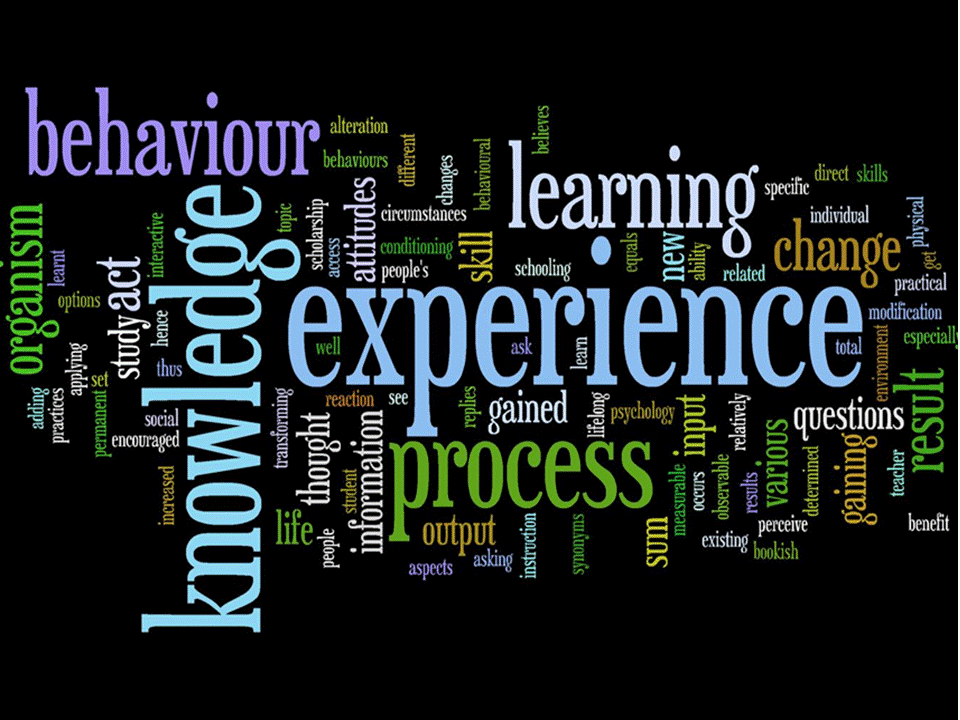
It occurs to me that it provides a very easy tool for the quick analysis of qualitative data such as transcripts of interviews. See here, too for its use in a similar way to reveal two different positions in a political debate. I'm sure others have got there first, but it seems to have plenty of potential...
16 January 2010
On the demise of another craft
I feel for this story. I have groped and fumbled round darkrooms, and loaded developing tanks under bedclothes and backed off from developing colour film doubting whether I could maintain the required temperature tolerances. I was never much good at it, so I really respect the skills of the masters (and mistresses) of the craft.
So let's celebrate the skill, and even mourn its passing, but its time is past, and PhotoShop and its competitors have the field. Get over it and move on!
But there is one difference, and it matters from a training point of view.
A year or so ago I asked Antonio (real first name) after a session I observed on his photography course, why the course still included "old-fashioned" analogue techniques (using film, and developing and printing it). Because, he told me, of their irreversibility. If you can "undo" and start again, and again, and again, there is little incentive to learn (as opposed just to try again).
So: to what extent does the cost of failure contribute to skill learning?
And--cost to whom? Sponsor, "provider", student...? what difference does that make?
15 January 2010
On living in the future
Excellent site; a children's book from 1972 showing what everyday life would be like in 2010, with comments. Some predictions quite odd, but others very prescient. H/t Boing Boing and the Browser.
11 January 2010
On the education of nurses (in the USA) --and parallels
I know that some readers are in nurse education, so you might be interested in this new report from the Carnegie Foundation for the Advancement of Teaching, in the USA [link from post title]. It parallels in some respects the plan for nursing to become an all-graduate profession in England by 2013. That proposal has been met with some scepticism in the UK.
It does seem that what Etzioni (1969) called the "semi-professions" have been making strenuous efforts in the latter half of the last century to enhance their status. As the citation below shows, he identified teachers, nurses and social workers as the main semi-professions, although since he was writing there are many more candidate occupations. I used to teach social workers, and more recently I have been teaching teachers, among whom have been nurses taking what the Nursing and Midwifery Council terms a "Recordable Teaching Qualification"--so I have a certain amount of knowledge in the area.
When I first taught in a primary school in the early sixties, some of my colleagues had only one year's training, or indeed higher education; they were known as "Emergency Trained" in a scheme developed in the aftermath of WW2 particularly to replace the large numbers of male teachers lost to the occupation. The norm was two years (although there was one teacher on the staff, apart from myself, who was quite untrained). Graduates did not have to be trained.
The first social work course I taught on was just a year long, with no specific entry requirements other than at least six months experience in residential child care. When I moved on from social work education, the Diploma in Social Work was just two years long, but in practice only taken by mature people (in age, at least) with some prior experience. The standard qualification has only been an undergraduate degree for a few years. Strangely at my former institution it is a Bachelor of Science award. Recently, (December 2009) the Social Work Task Force has reported, recommending the equivalent of a probationary year for newly-qualified staff, with extra support and supervision and the estbalishment of a National College for Social Work (presumably to replace the National Institute for Social Work which was closed in 2003...)
And nursing is now either a Diploma or Degree qualified profession, in both cases following a three year course. It moved from being work-based training with study blocks to coming under the auspices of universities in a programme called "Project 2000" from 1992 onwards. This was itself influenced by practice in the USA.
So what?
The first point is that as the fully-qualified staff have moved up the professional scale in each occupation, much of what they used to do has been taken over by lowlier and less-trained people. So much of the routine activity in nursing (and crucially the long-term and continuing patient contact) is now undertaken by Health Care Assistants, whose basic qualification is at National Qualifications Framework (NQF) level 3. Classroom Assistants have become increasingly important in schools, they may have minimal training or be relatively well-qualified with a Foundation Degree; from being primarily concerned to help children with special educational needs, their roles have become broader to the extent that the may be asked to "deliver" lessons using material prepared by a "proper" teacher. And social work has always relied heavily on an army of poorly-paid residential or domiciliary care assistants, nursery nurses and others often with very basic National Vocational Qualifications. So a caste division is established.
Of course, the fully-qualified staff cease to be direct practitioners--they become supervisors and managers. And because of the institutional anxiety engendered by the fact that direct "user" contact is increasingly undertaken by under-qualified staff, the quality assurance procedures have to be tightened which means that the qualified staff spend even more time in their offices dealing with paperwork... There is also a view which may or may not be legitimate that the new generations of highly-qualified staff are coming to see direct contact, particularly of a routine and even menial kind, as "beneath them".
And... Many commentators have made the point that raising the bar for the final qualification is likely to entail raising entry requirements and thereby excluding many potential candidates from under-represented groups. I'm not entirely convinced by this argument. Further and higher education institutions are in practice going out of their way to create ladders through sub- and para-professional qualifications to full professional recognition. And--purely on the basis of prejudicial respect for dozens of people I have had the privilege of guiding to that recognition--I need actively to be persuaded that people following this route are not the very best all-round practitioners in their fields. Their commitment, stamina, and practical experience (tempered perhaps by their toleration of being taught by prats like me--putting up with that is not a commendation)! ...does not merely add--it multiplies their practice wisdom.
But. From a different angle--
What is happening to those left behind?
Policies of social mobility which encourage able people to transcend their origins are great. Up to a point...
Discuss!
Etzioni, A. (1969) The Semi-professions and their Organisation: Teachers, Nurses and Social Workers, New York: Free Press
Hoggart, R (1957) The Uses of Literacy; Aspects of Working Class Life London; Chatto and Windus
It does seem that what Etzioni (1969) called the "semi-professions" have been making strenuous efforts in the latter half of the last century to enhance their status. As the citation below shows, he identified teachers, nurses and social workers as the main semi-professions, although since he was writing there are many more candidate occupations. I used to teach social workers, and more recently I have been teaching teachers, among whom have been nurses taking what the Nursing and Midwifery Council terms a "Recordable Teaching Qualification"--so I have a certain amount of knowledge in the area.
When I first taught in a primary school in the early sixties, some of my colleagues had only one year's training, or indeed higher education; they were known as "Emergency Trained" in a scheme developed in the aftermath of WW2 particularly to replace the large numbers of male teachers lost to the occupation. The norm was two years (although there was one teacher on the staff, apart from myself, who was quite untrained). Graduates did not have to be trained.
The first social work course I taught on was just a year long, with no specific entry requirements other than at least six months experience in residential child care. When I moved on from social work education, the Diploma in Social Work was just two years long, but in practice only taken by mature people (in age, at least) with some prior experience. The standard qualification has only been an undergraduate degree for a few years. Strangely at my former institution it is a Bachelor of Science award. Recently, (December 2009) the Social Work Task Force has reported, recommending the equivalent of a probationary year for newly-qualified staff, with extra support and supervision and the estbalishment of a National College for Social Work (presumably to replace the National Institute for Social Work which was closed in 2003...)
And nursing is now either a Diploma or Degree qualified profession, in both cases following a three year course. It moved from being work-based training with study blocks to coming under the auspices of universities in a programme called "Project 2000" from 1992 onwards. This was itself influenced by practice in the USA.
So what?
The first point is that as the fully-qualified staff have moved up the professional scale in each occupation, much of what they used to do has been taken over by lowlier and less-trained people. So much of the routine activity in nursing (and crucially the long-term and continuing patient contact) is now undertaken by Health Care Assistants, whose basic qualification is at National Qualifications Framework (NQF) level 3. Classroom Assistants have become increasingly important in schools, they may have minimal training or be relatively well-qualified with a Foundation Degree; from being primarily concerned to help children with special educational needs, their roles have become broader to the extent that the may be asked to "deliver" lessons using material prepared by a "proper" teacher. And social work has always relied heavily on an army of poorly-paid residential or domiciliary care assistants, nursery nurses and others often with very basic National Vocational Qualifications. So a caste division is established.
Of course, the fully-qualified staff cease to be direct practitioners--they become supervisors and managers. And because of the institutional anxiety engendered by the fact that direct "user" contact is increasingly undertaken by under-qualified staff, the quality assurance procedures have to be tightened which means that the qualified staff spend even more time in their offices dealing with paperwork... There is also a view which may or may not be legitimate that the new generations of highly-qualified staff are coming to see direct contact, particularly of a routine and even menial kind, as "beneath them".
And... Many commentators have made the point that raising the bar for the final qualification is likely to entail raising entry requirements and thereby excluding many potential candidates from under-represented groups. I'm not entirely convinced by this argument. Further and higher education institutions are in practice going out of their way to create ladders through sub- and para-professional qualifications to full professional recognition. And--purely on the basis of prejudicial respect for dozens of people I have had the privilege of guiding to that recognition--I need actively to be persuaded that people following this route are not the very best all-round practitioners in their fields. Their commitment, stamina, and practical experience (tempered perhaps by their toleration of being taught by prats like me--putting up with that is not a commendation)! ...does not merely add--it multiplies their practice wisdom.
But. From a different angle--
What is happening to those left behind?
Policies of social mobility which encourage able people to transcend their origins are great. Up to a point...
- in a norm-referenced world, for everything which goes up, something must go down.
- Gramsci (1971) (Italian marxist theorist imprisoned by Mussolini) was concerned about the development of "organic intellectuals" among the working class. Roughly, "traditional intellectuals" are people who think of themselves as such; organic intellectuals are people who undertake intellectual work without recognising themselves or being recognised by others. Gramsci argued that organic intllectuals were a by-product creation of the ruling classes, but that they also had counterparts "embedded" as we should now say within the working classes, in voluntary and community groups, in unions, in churches (not sure where he stood on religion) and families. In his view it was vital that they be enlisted to lead the revolutionary struggle.
- The problem from this perspective is of course that educationally-promoted social mobility may be seen as "creaming off" the working-class organic intellectuals, thereby leaving working-class communities leaderless and even more disenfranchised than before; hence, it may be argued, "sink estates" and so-called "broken Britain" (and perhaps vulnerability to right-wing demagoguery), as opposed to Hoggart's account of pre-WW2 working-class life in "The Uses of Literacy" (1957).
- The rise of the semi-professions fits into this argument because of their accessibility to aspirants.
Discuss!
Etzioni, A. (1969) The Semi-professions and their Organisation: Teachers, Nurses and Social Workers, New York: Free Press
Hoggart, R (1957) The Uses of Literacy; Aspects of Working Class Life London; Chatto and Windus
Subscribe to:
Posts (Atom)


